The Economics of a Great RFQ
In international trade, time is money. For professional automotive aftermarket importers, wholesalers, and fleet managers, the speed and accuracy of sourcing feedback directly dictate local market competitiveness. However, many procurement managers struggle with delayed factory responses, inconsistent pricing, and high fitment defect rates. The root cause is almost always a poorly structured Request for Quotation (RFQ).
When you learn how to request auto parts quotation from China with technical precision, you are doing more than just asking for a price sheet. You are translating complex mechanical and electrical specifications into a standardized format that Chinese factories can evaluate instantly. A high-quality auto parts RFQ guide separates professional buyers from retail-level inquiries. This distinction helps you secure priority support, access more competitive pricing tiers, and ensure 100% fitment accuracy before production begins. This guide outlines the exact, step-by-step framework to optimize your bulk sourcing process.
The Six Golden Data Fields for an Auto Parts RFQ
Automobile parts are not generic, off-the-shelf commodities. A single vehicle model year can have dozens of minor trim, bracket, socket, and wiring variations that alter the physical or electrical layout of the light, grille, or bumper. To eliminate ambiguity, every line item in your wholesale RFQ must include these six critical fields:
- OEM/OE Part Number: The gold standard of automotive procurement. OE numbers are unique, universal identifiers. Sourcing by OE number completely eliminates regional naming differences and ensures the factory's tooling matches original specifications exactly.
- Vehicle Make, Model, and Production Year: Always specify the exact manufacturing year range. Do not write "Corolla New Model" or "Prius Old Model." Use precise ranges like "Toyota Hilux Revo 2016-2020."
- Side Position (LH / RH / Front / Rear): Clearly designate the side position. For lighting, this is critical because assemblies are asymmetrical. Left-Hand (LH) is the driver's side in LHD countries (or passenger's side in RHD markets), and Right-Hand (RH) is the opposite.
- Clear Product Photos (Front, Back, & Plugs): If you are sourcing a part where the OE number is missing or obscured, provide clear photos of both the front face and the back housing, paying special attention to the wiring pin connections.
- Target Order Quantity (MOQ Correlation): Auto manufacturing involves high setup and raw material costs. Vague requests like "give me your best price for some headlights" are often ignored. Always provide a clear target quantity per SKU (such as "20 pairs" or "100 pieces") to secure accurate volume-discount pricing.
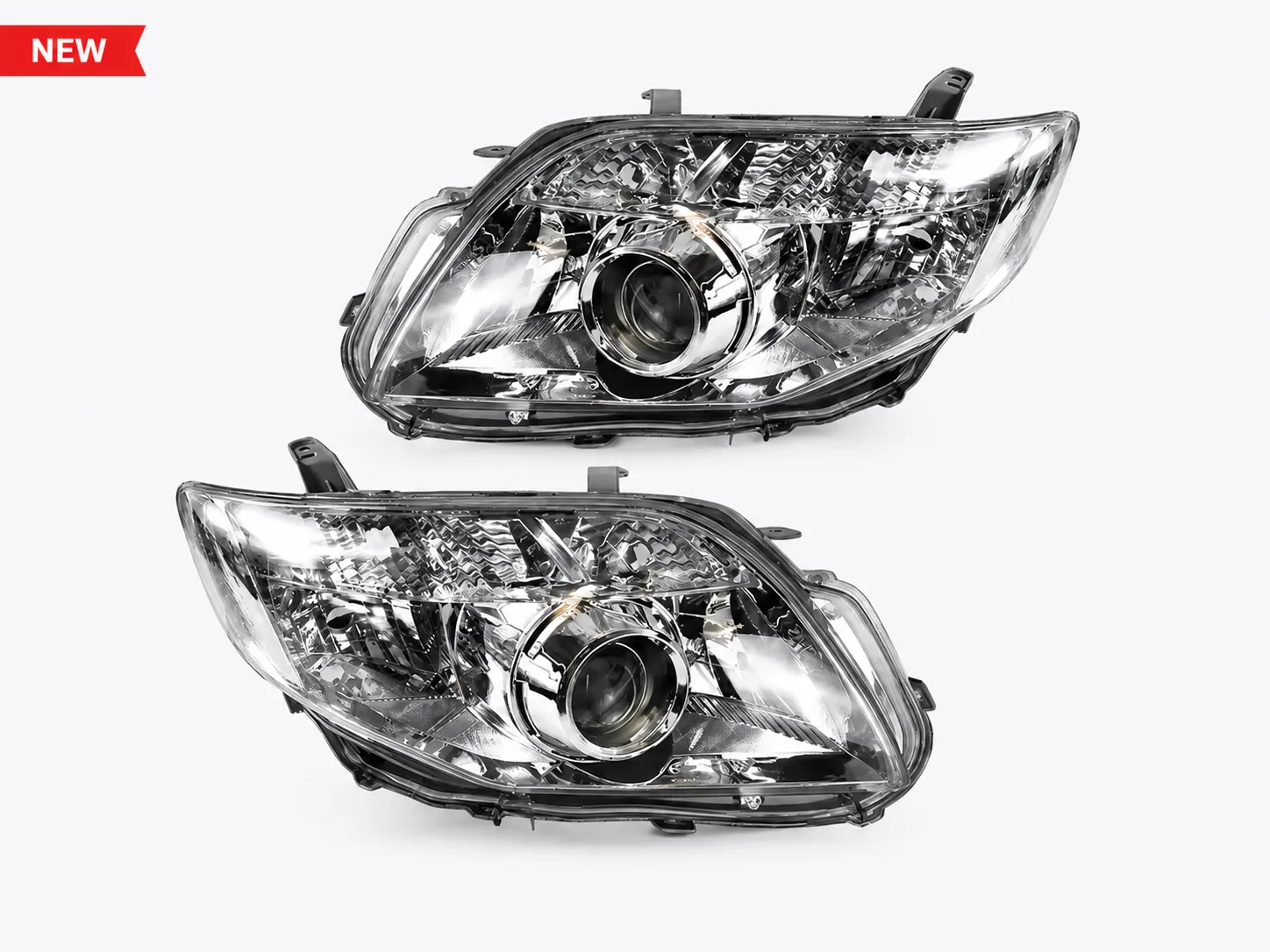
- Destination Country and Driving Orientation (LHD vs. RHD): Headlight projector beams must be physically shielded to match local driving lanes. Sourcing LHD headlights for an RHD country will fail local vehicle inspections. Always specify your target market's driving orientation.
Common Pitfalls and How to Avoid Them
To keep your sourcing operations running smoothly, run through this list of common B2B procurement mistakes and make sure your team is aligned on best practices:
- Sourcing by Name Only: Requesting "headlights for 2015 Toyota RAV4" without cross-referencing OE codes is a recipe for disaster. The RAV4 has different headlight shapes, mounting points, and lens configurations depending on whether it is a North American, European, or Japanese domestic market build.
- Failing to specify bulb technology (Halogen vs. LED vs. Xenon HID): Modern vehicles offer different headlight trims on the exact same chassis. A full-LED assembly cannot plug directly into a halogen harness without a custom adapter, and the manufacturing costs of the two housings vary by hundreds of dollars.
- Ignoring Packaging Specifications: Highly fragile plastic parts can easily break during ocean transport. Vague RFQs that fail to specify heavy-duty export packaging standards often lead to broken mounting brackets and high transit loss rates.
Supplier Psychology and Negotiation
To secure the best support and pricing from Chinese manufacturers, it helps to understand their internal quoting psychology. When an engineering-focused factory receives a highly detailed, organized RFQ with complete OE numbers, clear side positions, target quantities, and compliance certifications, they immediately recognize you as a professional, high-volume buyer.
As a result, your inquiry is instantly prioritized over thousands of vague, disorganized emails. Factories are far more willing to offer lower profit margins and flexible MOQs to professional buyers because they know the transaction will involve minimal administrative friction, zero return claims, and highly predictable reorder cycles.
| Buyer Inquiry Type | RFQ Detail Level | Factory Response Speed | Price & Support Quality | |
|---|---|---|---|---|
| Amateur Inquiry | "Need headlights for 2012 Corolla, send price." | Very Slow (often ignored) | Standard Retail Pricing (No discounts) | High fitment risk |
| Professional Buyer | Lists vehicle make, model, and year range only. | Medium (requires clarification) | Moderate Wholesale Tiers | Medium fitment risk |
| Enterprise Importer | Provides exact OEM numbers, side specs, and MOQ. | Extremely Fast (24 hours) | Bottom-tier Factory Pricing | Zero fitment risk |
Streamlining RFQs with I-Pack Auto Parts
Guangzhou I-Pack Auto Parts Co., Limited is a premier, specialized supplier of high-durability aftermarket automotive lighting and exterior body components. We operate specifically in the B2B sector, serving professional international distributors, wholesalers, and fleet managers.
We have engineered our digital platform to make the B2B RFQ process as fast and seamless as possible. Instead of dealing with messy Excel spreadsheets or scattered emails, buyers can browse our organized vehicle categories and use our integrated OE Number Search to find exact-match parts. By adding your desired SKUs to our centralized Inquiry List, you can compile and submit a highly detailed, technically complete bulk RFQ with all OEM numbers, side positions, and vehicle specifications instantly attached. This streamlined workflow reduces administrative overhead and ensures you receive a highly competitive factory-direct quote within 24 hours.
Recommended Next Steps
Ready to experience a highly professional, technically precise B2B auto parts sourcing experience?
- Explore our complete Product Catalog to find your target parts.
- Compile and submit a consolidated bulk quote request through our Inquiry List.
- Learn more about our strict quality assurance protocols on our Quality Control Page.